Op-amp Basics
Please Log In for full access to the web site.
Note that this link will take you to an external site (https://shimmer.mit.edu) to authenticate, and then you will be redirected back to this page.
Consider an operational amplifier that behaves according to the simple model
\frac{dV_{o}(t)}{dt} = -V_o(t) + K(V_+ - V_-)
Suppose this op-amp is connected in a non-inverting amplifier configuration
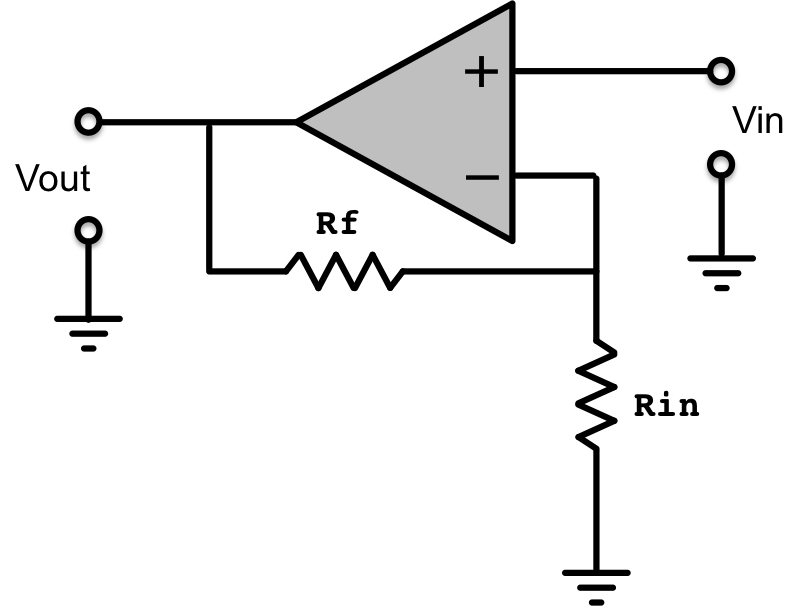
The gain of this op-amp circuit (\frac{V_{out}}{V_{in}}) is approximately
1 + \frac {R_f}{R_{in}}
Suppose V_{in}(t) = u(t), that is, suppose the input is a unit step. For each of the following circuit gains, how long (in seconds) will it take for the output to rise to 1-e^{-1} of its final value (that is, what is the time constant of the rise time). Assume the internal gain of the op amp is K = 10^6
NOTE: If you are using the step command in Matlab make sure you can see the dynamics of the step. If the initial time scaling is zoomed out too far fix this by using the time argument of the step command like so: step(H,t) where t is a time in seconds.
circuit gain = 10

circuit gain = 100
circuit gain = 1000